

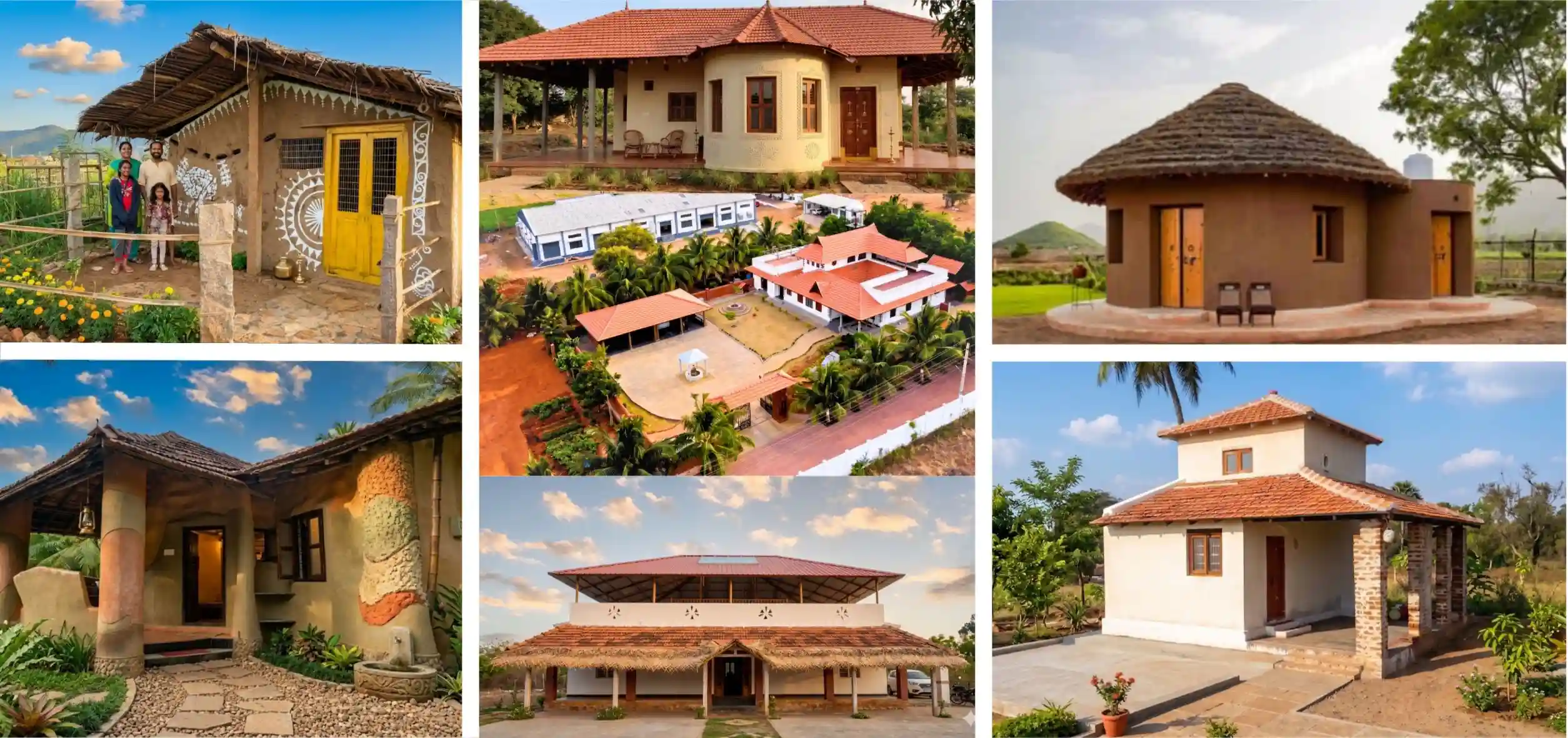
Hand-Sculpted Sanctuaries: The Rise of Owner-Built Natural Homes in India
Across India, everyday people with no construction background are building their own mud houses — using mud, lime and bamboo instead of cement. These owner-built natural homes, from a Delhi rooftop to an Arunachala monk’s hut, show it can cost as little as ₹18,500 and fit any life.
Building a house with your own hands is a very basic human instinct. Somewhere along the line, we handed this deeply personal job over to heavy machinery, cement, and contractors. But today, a growing number of people are choosing owner-built natural homes — building their own mud houses with mud, bamboo, and lime.
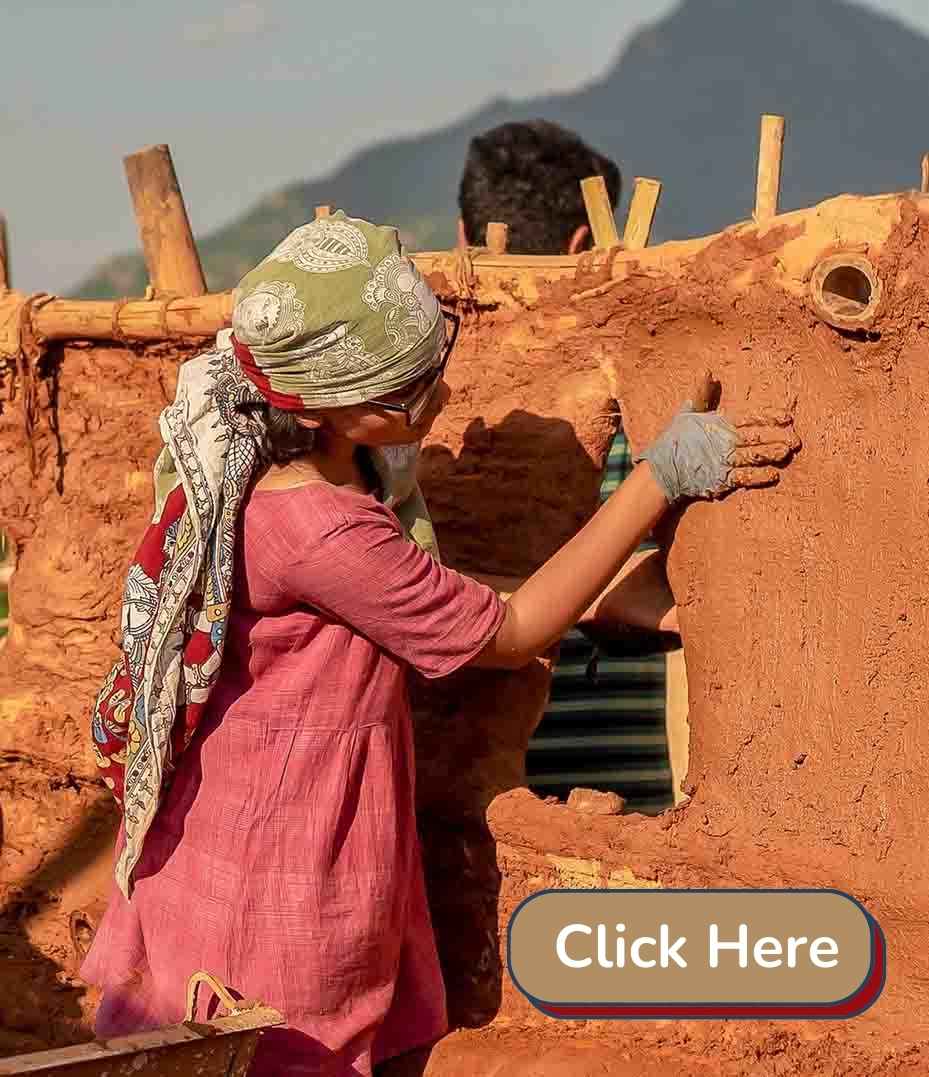
Through hands-on workshops and online courses at Thannal, everyday people with absolutely no construction background are learning how to shape their own living spaces. They are picking up old, forgotten methods like cob, wattle and daub, earthbags, and lime plastering — building walls that breathe and spaces that actually fit their lives.
Here is a look at some of these owner-built homes, ranging from city rooftops to quiet forest retreats.
What owner-built natural homes look like
From city rooftops to forest farms, these are real mud houses, cob houses and earthbag homes — each built by its owner. If you have ever wondered how to build a mud house of your own, these fifteen stories show the way.
Urban builds and weekend projects
For people living in cities or working demanding nine-to-five jobs, building a natural home might seem out of reach. But these builders proved that a lack of space or a busy schedule is not an excuse.
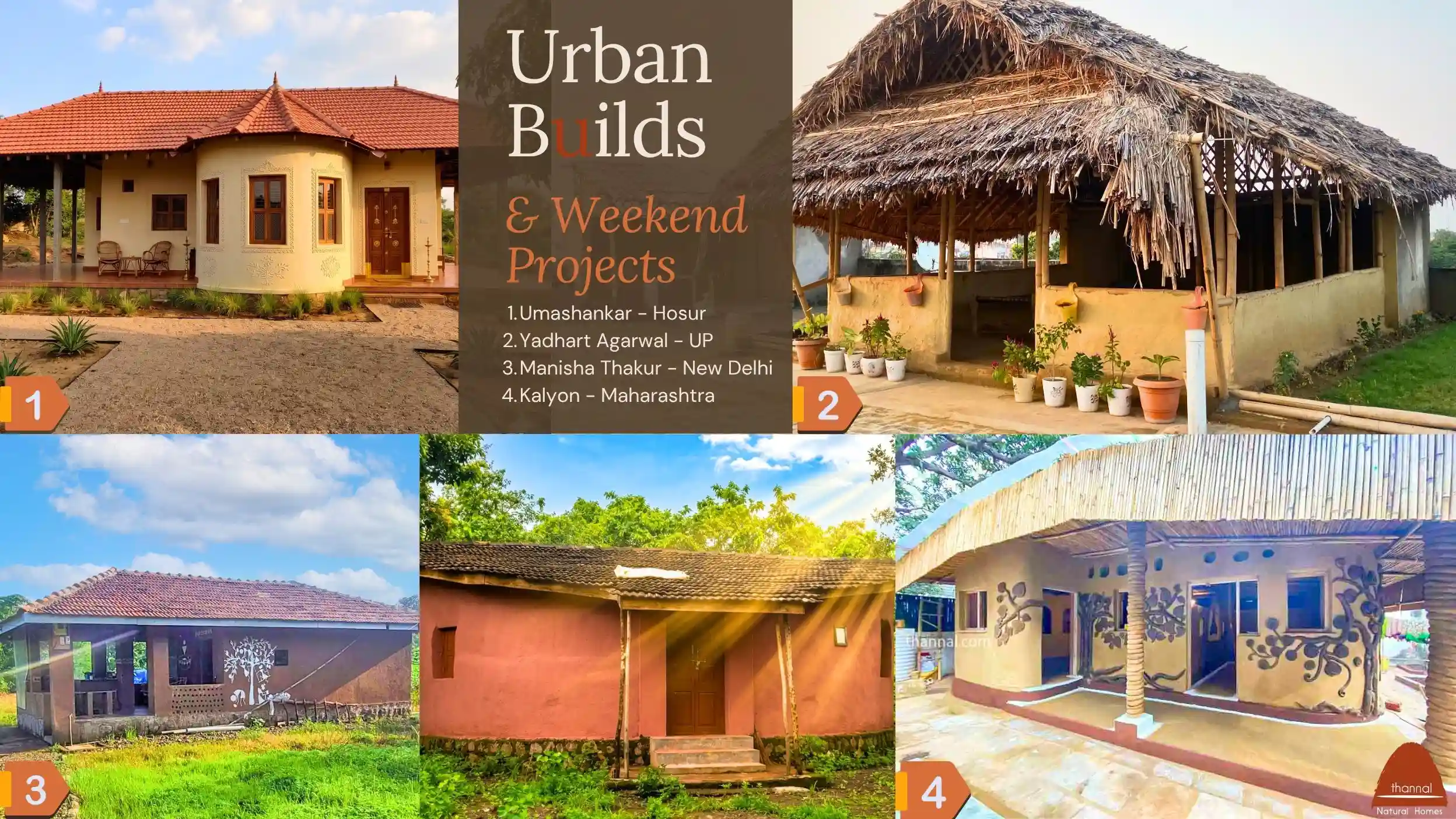
- The Rooftop Bamboo House (Bulandshahr, UP): Architect Yatharth Agarwal built a 300 sq. ft. lightweight room on his terrace during the 2021 lockdown — wattle and daub, neem-treated bamboo, and a sugarcane thatch roof — a quiet space for yoga and gardening for just ₹1,00,000.
- An Oasis in the City (New Delhi): Manisha Thakur built a peaceful 960 sq. ft. adobe-brick home in the middle of bustling Delhi for just ₹9 lakhs.
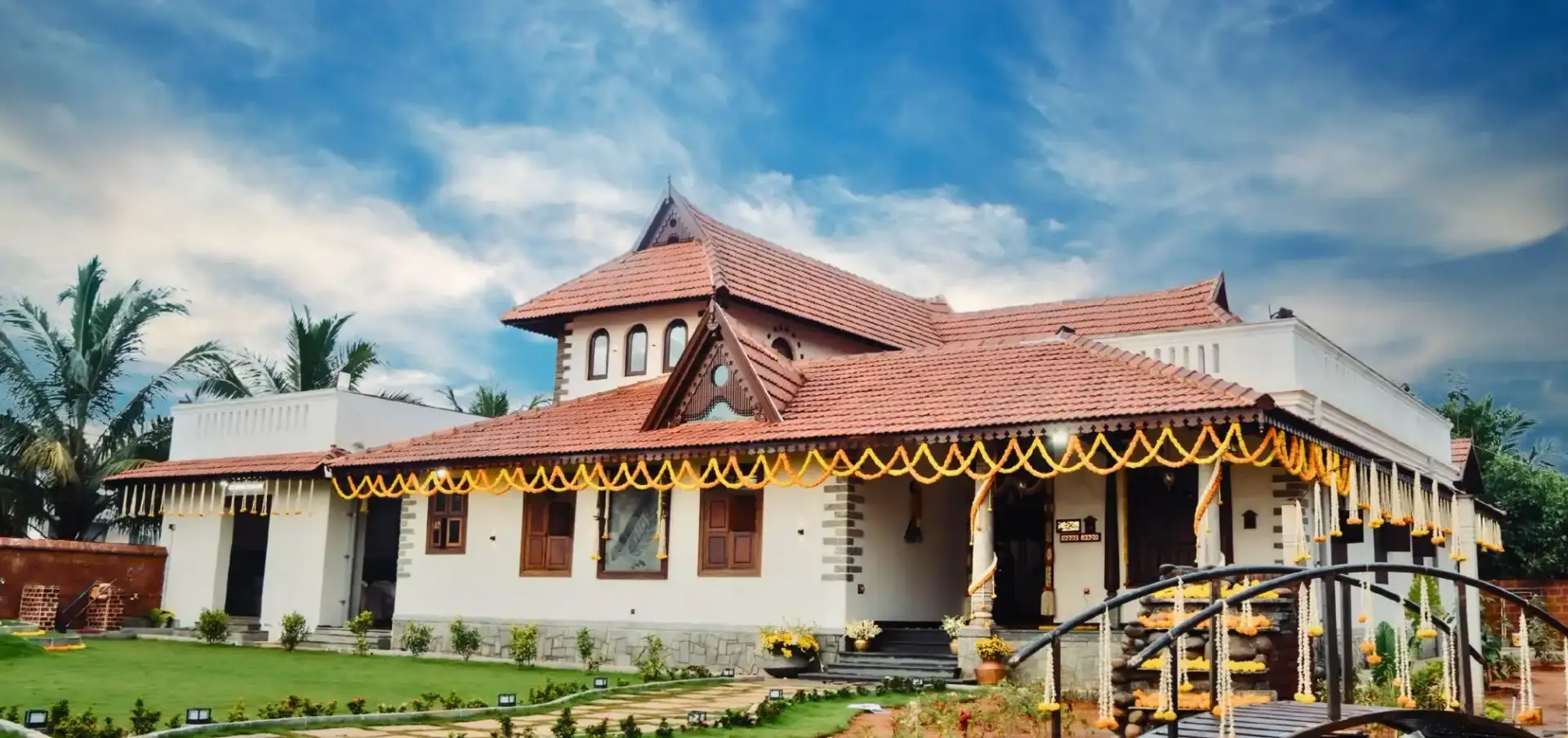
- The IT Professional’s Home (Bangalore): Over three years of weekends and holidays, Umashankar acted as his own mason and carpenter to build a 1,700 sq. ft. duplex cob house with an intricate octagonal terracotta roof.
- The Food Blogger’s Cob House (Maharashtra): Kalyon built a 540 sq. ft. shuttered cob house, mixing Kadukkai water and corn starch into his plaster. The ₹4.5 lakh house features hand-made Virali wall art and a bathroom wall built from old glass bottles.
Bringing back traditional architecture
By working with their own hands, these builders revived regional architectural styles — showing that beautiful, historical designs don’t need industrial cement.
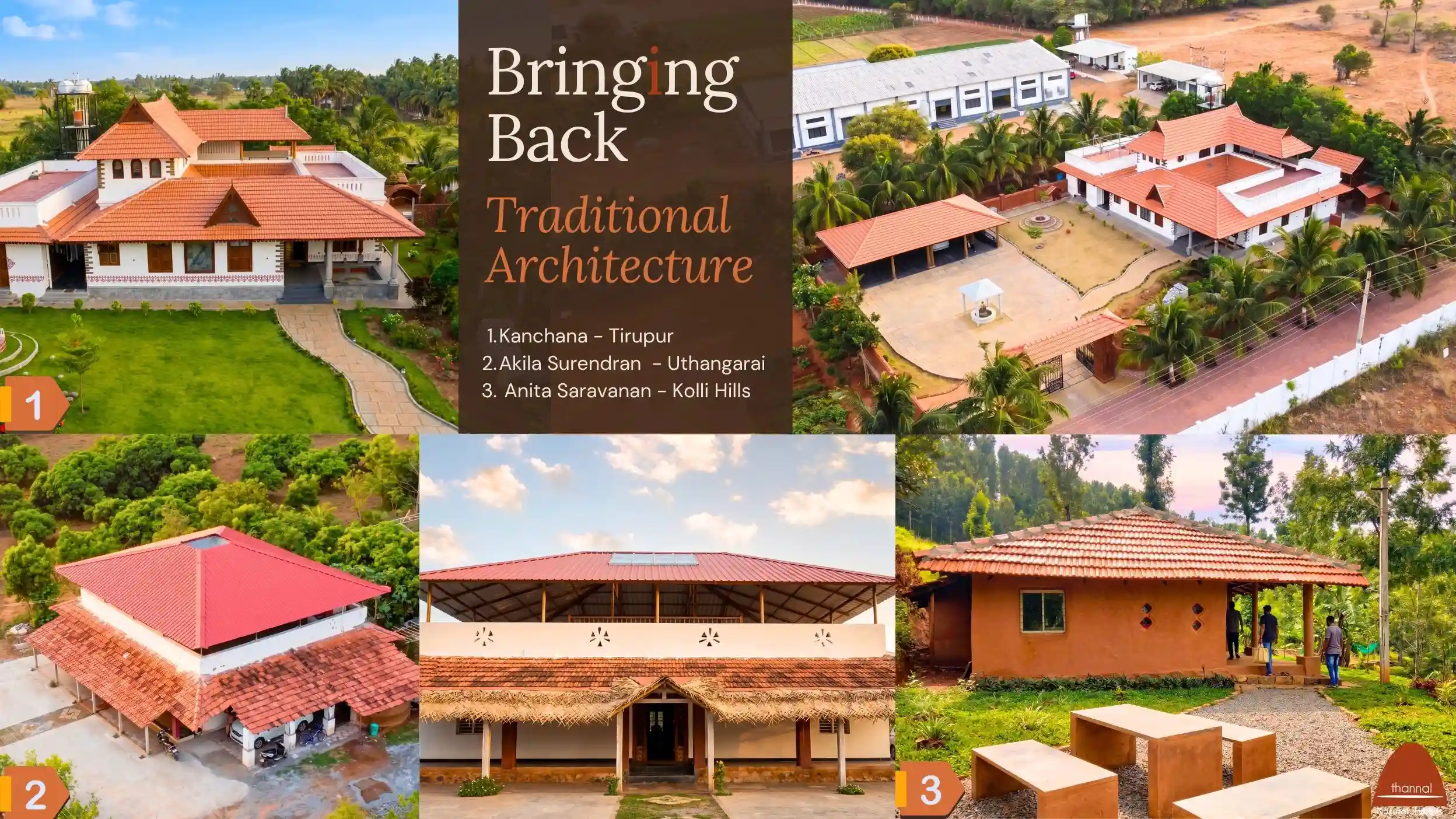
- The Chettinad Home (Tirupur, Tamil Nadu): Dancer Kanchana Rajendran built a 4,500 sq. ft. home with zero cement — Chettinad lime plasters, Tadelakt finishes, and open courtyards bridging heritage with healthy living.
- The Courtyard House (Uthangarai, Tamil Nadu): Interior designer Akila Surendran moved back to her ancestral village to lead the build of a 3,070 sq. ft. traditional courtyard home, using adobe bricks, bamboo, and reclaimed wood.
- The Pandemic Retreat (Kolli Hills, Tamil Nadu): During the pandemic curfews, engineering teacher Anita Saravanan built a 1,000 sq. ft. cob home in the hills — for half the cost of a regular cement building.
Farms, forests, and small shelters
These projects show how a building can blend into the land it sits on, using what is immediately available.
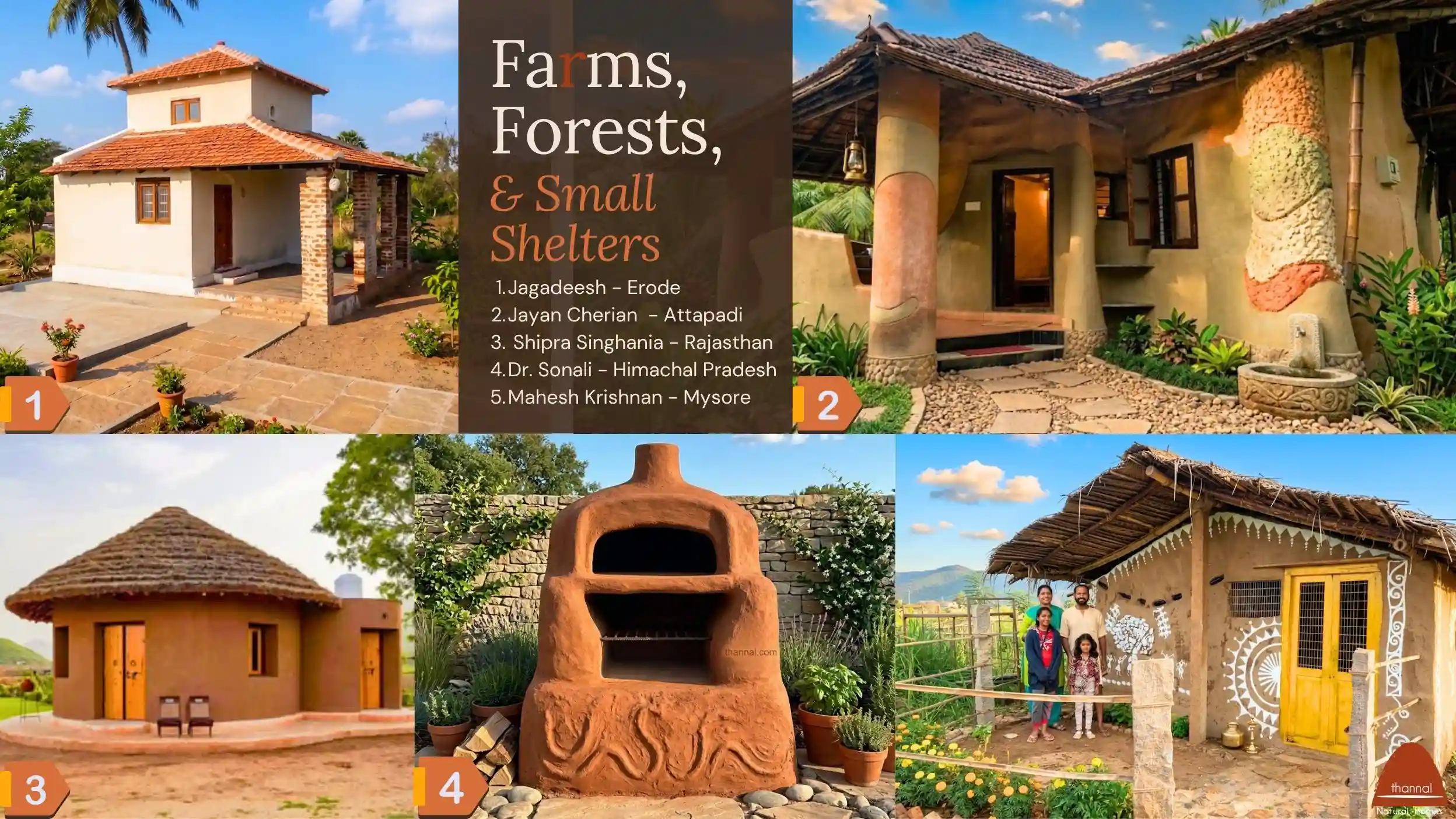
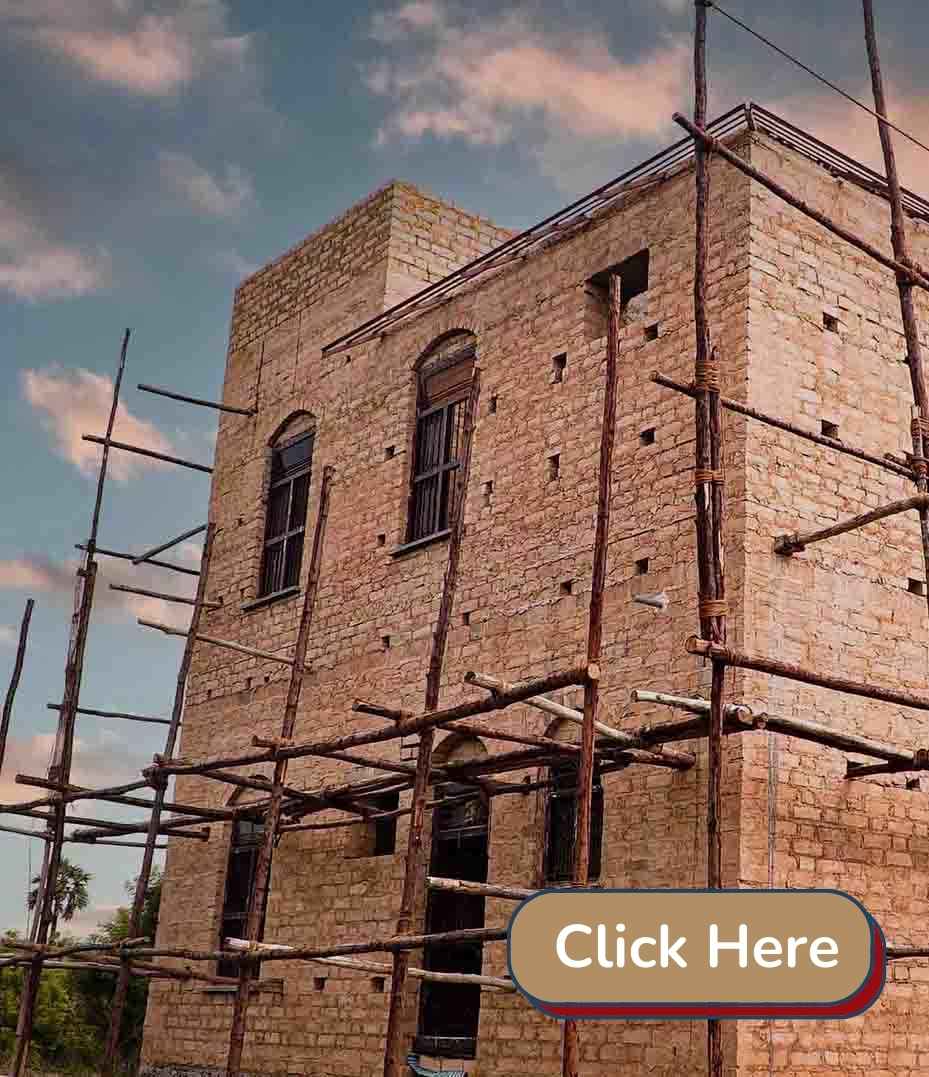
- The Two-Story Farmhouse (Erode, Tamil Nadu): Young farmer Jagadeesh built a two-story (G+1) mud house on his farm using burnt bricks set in mud and lime mortar, finishing the 570 sq. ft. home for ₹7.7 lakhs.
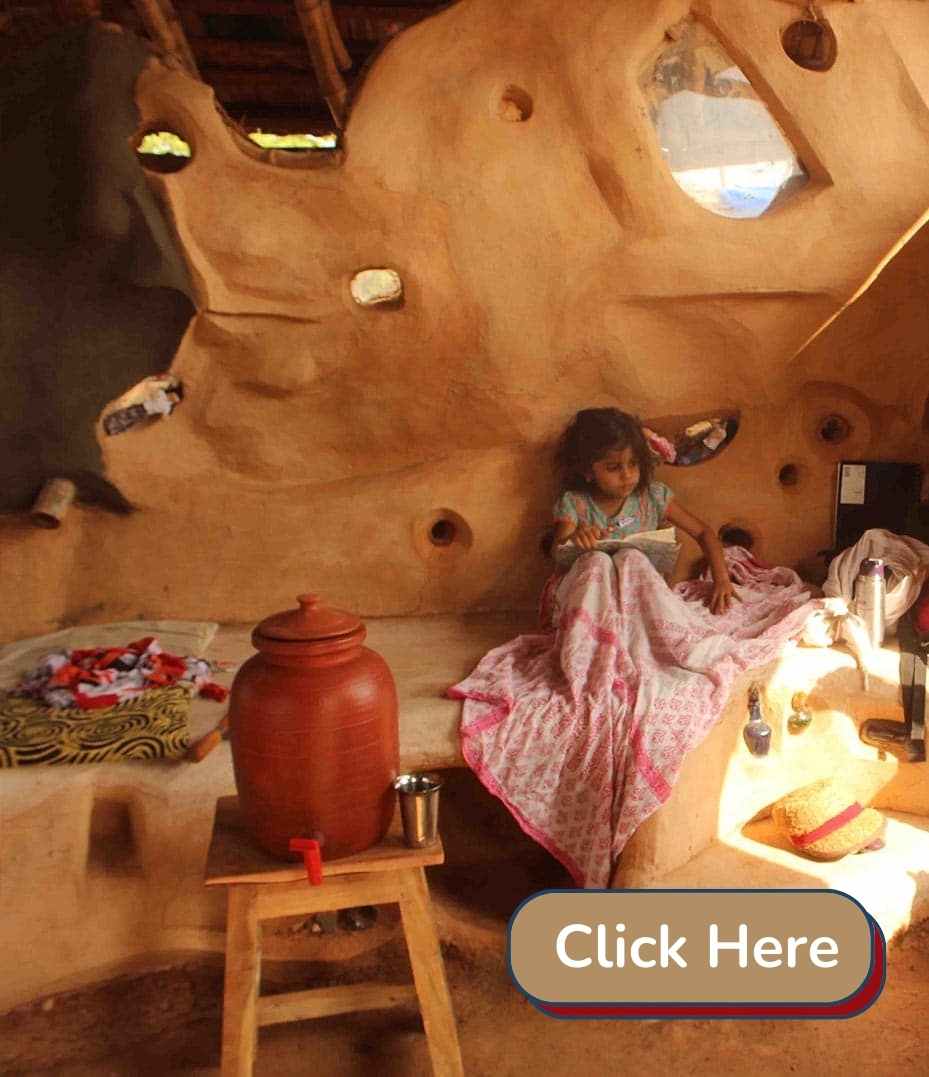
- The Wattle and Daub Home (Attappadi, Kerala): Farmer Jayan Cherian built a home with his family using materials straight from the forest — bamboo cut from a nearby stream for the frame, mud and tree resins for the walls.
- The Earthbag Studio (Alwar, Rajasthan): Shipra Singhania designed a 300 sq. ft. circular earthbag house using stone, earthbags, thatch, and mud plasters, keeping local Rajasthani methods alive.
- The Mud Oven (Himachal Pradesh): Sonali Yadav proved natural building can start very small, using local mountain mud to build a traditional cooking oven.
- The ₹18,500 Shelter (Mysore, Karnataka): Mahesh Krishnan quit his hotel job to build a simple 300 sq. ft. mud house. He gathered 80% of his materials from the site and finished the cool, quiet space himself in 125 days for under ₹20,000.
The meditative path
For some, packing mud and smoothing lime is not just construction; it is a spiritual practice that shapes the soul as much as the structure.
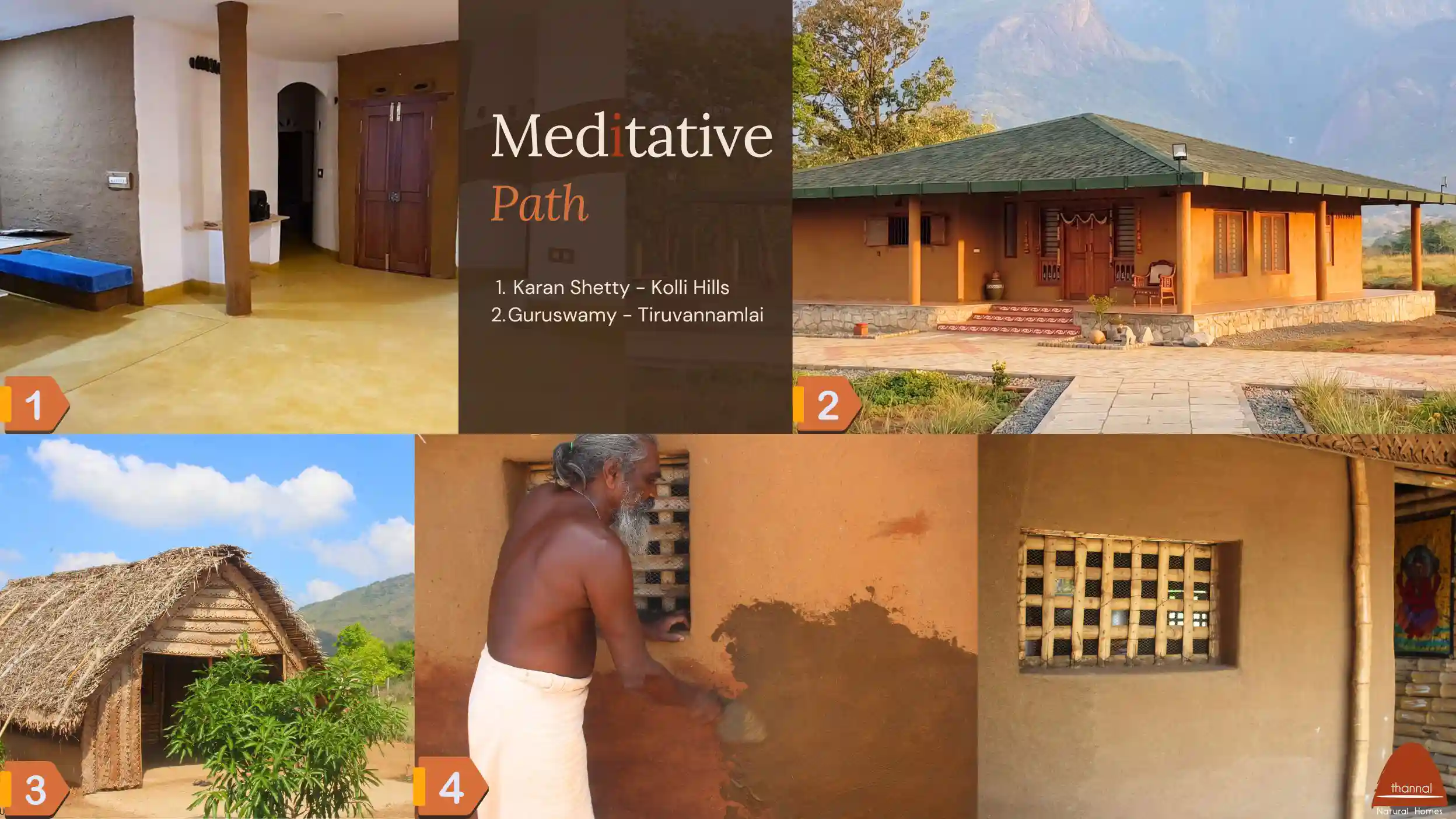
- The Introspective Builder (Agasthya Hills, Tamil Nadu): Karen Shetty crafted her home using Madras terrace roofing and traditional Thappi lime plaster, treating each layer of mud and brushstroke of lime as a meditative prayer.
- A Monk’s Serene Dwelling (Arunachala, Tamil Nadu): At the foothills of Arunachala, Guru Swami dedicated just three hours a day over two months to build a humble 200 sq. ft. shelter — red mud, sand, rice husk and cow dung, hand-plastered into walls that breathe.
A return to the soil
When we build with our own hands, we remember an old, quiet truth.
We are just passing by,
Mother earth has given her place.
Why shan’t we use it wise,
As we are not the ace.
And what we own otherwise.
Everything we use is just borrowed from the earth. We need to make sure that when we leave, the shelters we built don’t leave a permanent, polluted mark behind.
How to start your own build
Building your own home is the best way to reduce construction costs, understand your materials, and put your own energy into your walls. If these owner-built natural homes have inspired you, here is how to start:
- Watch the free course — a basic understanding of Indian materials and methods: Introduction to Natural Building (Free Course)
- Learn online, step by step: Self-Paced Online Natural Building Courses
- Work with your hands at an Indian Hands-On Natural Building Workshop.
- Understand the economics: read The Cost of Natural Building.
- Explore the movement: the Back Home Documentation Series.
What began over eighteen years ago as a quiet, two-person journey by Ar. Biju Bhaskar and Sindhu Bhaskar has blossomed into a nationwide return to the earth. Since founding Thannal in 2011, they have hosted more than 75 hands-on workshops, guiding over 5,000 learners to physically reconnect with the mud beneath their feet. Beyond the campus, this wisdom has empowered over 6,000 online learners globally to become their own builders.
In Gratitude and Grace — To witness raw earth transform into a sanctuary is to witness a silent miracle. My deepest gratitude flows to Ar. Biju Bhaskar and Sindhu Bhaskar, the founders of Thannal, who walked ahead to clear the path for pure natural building. They lead with the quiet wisdom found in Ar. Biju’s constant reminder: “We follow our followers.” And to the Mountain, Arunachala, under whose vast, watchful grace all of this is embraced — I bow.
Frequently Asked Questions (FAQ)
What is natural building, and why is it making a comeback?
Natural building is a philosophy that reconnects us to the earth, using locally sourced, non-toxic materials like mud, lime, bamboo, stone, and reclaimed wood. It is regaining popularity because people want homes that are healthy, breathable, and environmentally responsible — away from the lifeless feel of industrial cement.
How do I build a mud house of my own?
Start small and learn the craft first. Watch the free Introduction to Natural Building course, then join a hands-on workshop to practise cob, wattle and daub, earthbag and lime plastering. Most owner-builders begin with a small room or studio before building a full mud house.
Will a natural home melt in the rain or fall apart?
This is a common misconception. Buildings made 100–200 years ago with natural methods still stand. With traditional stabilizers, proper roof overhangs, and moisture-protecting foundations, natural buildings are resilient and long-lasting.
So, how can I learn how to build a mud house?
That is the most important next step on this journey. When we began over 15 years ago, we dreamed of a day when many people would be inspired to teach these beautiful techniques. Today, Thannal offers three main pathways for you to learn:
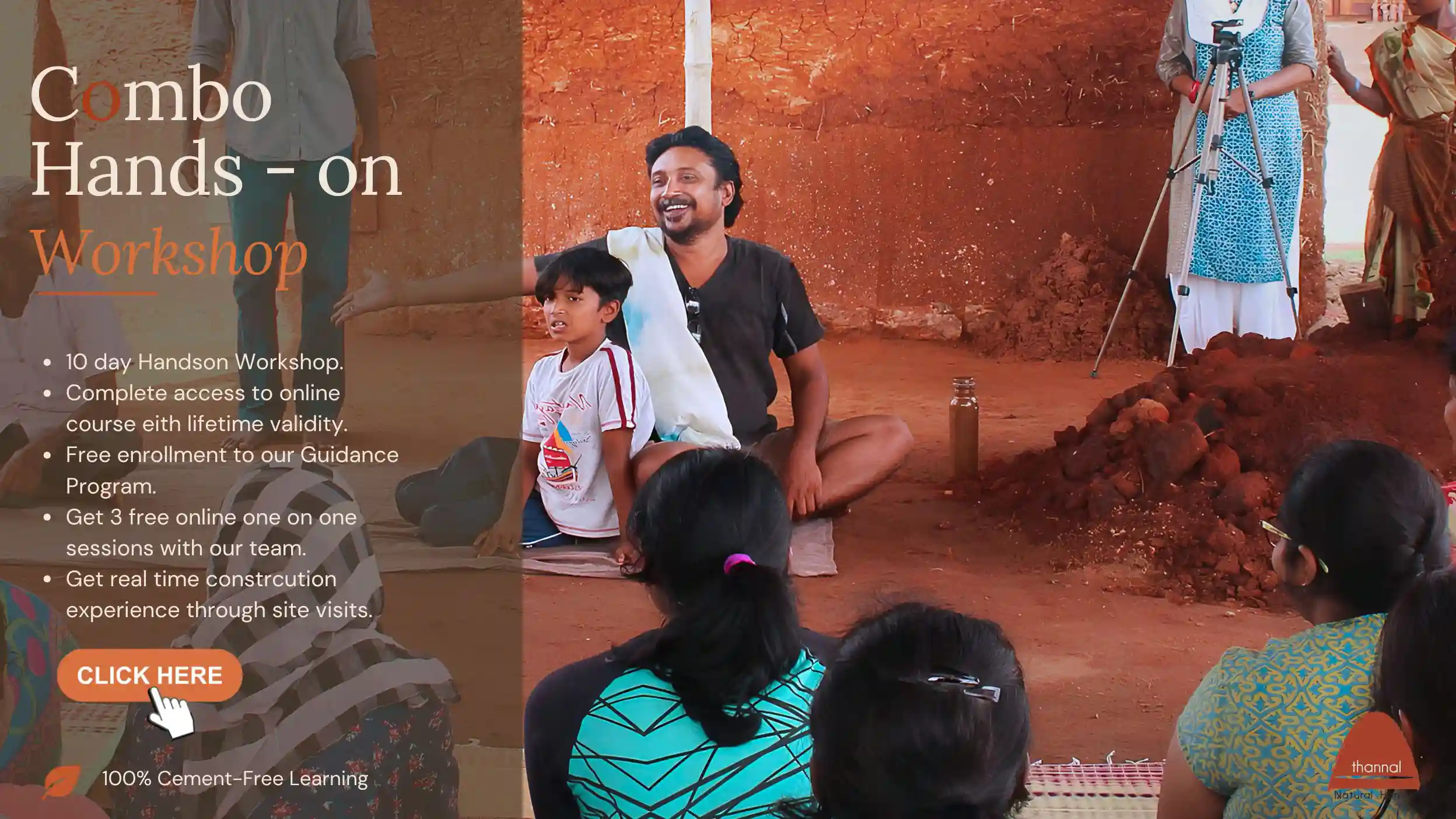
- The Immersive Experience: Our 10-day Combo Workshop is the deepest way to learn. It combines hands-on work with lifetime access to our complete self-paced online course and digital syllabus.
- Study from Anywhere: If you cannot attend a workshop in person, you can start with our Self-Paced Online Courses. They allow you to study all the techniques from home, guided by our digital syllabus.
- A Deeper Commitment: For those on a professional path, like architecture or civil engineering students, we also offer long-term courses and apprenticeships. Each path is designed to empower you with the knowledge to build with confidence and soul.
Can I build a multi-storey home without cement?
Yes. Multi-storey natural buildings are common in history and today — the mud towers of Shibam, Yemen have stood nearly a thousand years. You can build a 2–3 storey home in India using pure natural materials.
How much does a natural building actually cost?
There is no fixed price per square foot, because natural building is not an industrial process. Cost varies with your site, design, techniques, and involvement (DIY vs. professional management). Durable traditional techniques upfront reduce long-term repair costs.
Is natural building high-maintenance compared to concrete?
Concrete is assumed to be zero-maintenance, but rarely is over time. A natural home is a breathing entity; with strong foundations and quality lime plasters, maintenance is remarkably low.
If I hire Thannal to manage my project, do I still need to learn the craft?
Yes. We encourage even clients to gain foundational knowledge through our workshops or courses, so you can oversee the work with confidence and care for your home for decades
Where is the best place to start my journey?
Start by gaining knowledge — the free Introduction to Natural Building course for principles, a hands-on Combo Workshop for practical experience, or our Project Services if you have a site ready.

Ar.Biju Bhaskar & Ar.Dharan Ashok
This article is by Natural builder and Architect Biju Bhaskar and Dharan Ashok. This article is a part of the Thannal Homes series.

2 thoughts on “Hand-Sculpted Sanctuaries: Owner-Built Natural Homes in India”
Namaste Amishji,
Thank you so much for taking the time to share your thoughts. It brings us great joy to hear from one of our alumni.
You are absolutely right about how society often views natural building and materials. It is a misunderstanding we hope to gently change by simply showing that these homes are practical, beautiful, and dignified.
We completely agree with your assessment of cement. Sealing the earth harms the soil, and we feel a deep responsibility to stick to pure natural building so our architecture can breathe and respect nature.
Pointing out the rising AQI in our cities is a harsh but true reality check. Zero-cement building is no longer just a rural concept; it is becoming a practical necessity for our health in urban spaces as well.
We will keep doing our very best to write more and spread this awareness. Thank you for walking this path with us and standing by Mother Earth.
Thannal Team.
Excellent article Sir (Architect Biju Bhaskar),
For most of the urban educated, Mud & Lime building seems like going back to the illiterate times. But this article would definitely make them think rightly about it, and why not?
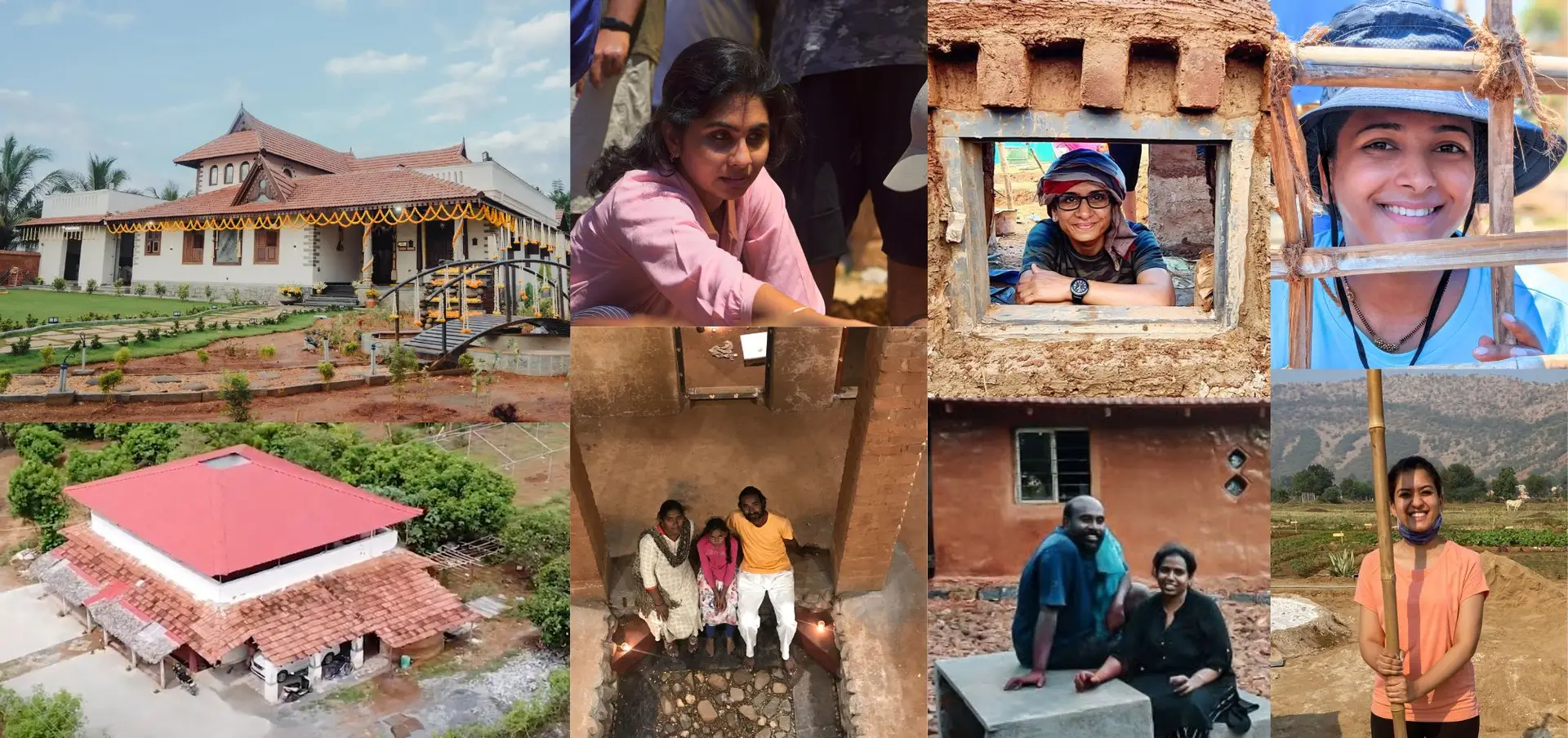
You have aptly given many images of Mud & Lime homes built by Thannal students, along with their cost. May be a hundred have ventured in the last 5 years and this would become a necessity for thousands or lakhs in the coming years. Let the awareness come.
Putting Cement onto the Earth is polluting it forever. It is making her (my Mother Earth) Infertile! A great paap#! (#’Paap’ means any action, thought, or speech that goes against the laws of nature.)
Now with rising awareness about AQI; having the worst of it in every Tier 1 & 2 city, highly educated people must think and educate others of having natural buildings for themselves.
There could not have a time -less perfect than this- to write and publish such an article.
Keep writing more, Biju ji.
– Amish Saraiya (Thannal student April 2022)
Surat